

Iberá Wetlands: South America’s Safari
The Iberá Wetlands (Esteros del Iberá) in Corrientes Province, northeastern Argentina, form one of the largest freshwater wetland systems on Earth — roughly 1.3 million hectares of marshes, lagoons and grasslands, with more than 700,000 hectares protected within Iberá National Park and Iberá Provincial Park. Home to capybaras, caimans, marsh deer, giant anteaters, more than 350 bird species and a growing population of wild jaguars, Iberá offers the closest thing to a safari South America has: open landscapes, remarkable wildlife density, expert local guides and remote lodges. And unlike the world’s famous safari destinations, you will often have it almost entirely to yourself.
Ask a well-travelled friend to name the planet’s great wildlife destinations and you will hear the usual suspects: the Serengeti, the Okavango Delta, the Galápagos, perhaps Brazil’s Pantanal. Iberá rarely makes the list — and that is precisely the point. Over the past two decades, while few were watching, this vast Argentine wetland has quietly become the stage for the most ambitious rewilding project in the Americas, and one of the most rewarding wildlife-viewing destinations anywhere in the hemisphere.
Where — and What — Are the Iberá Wetlands?
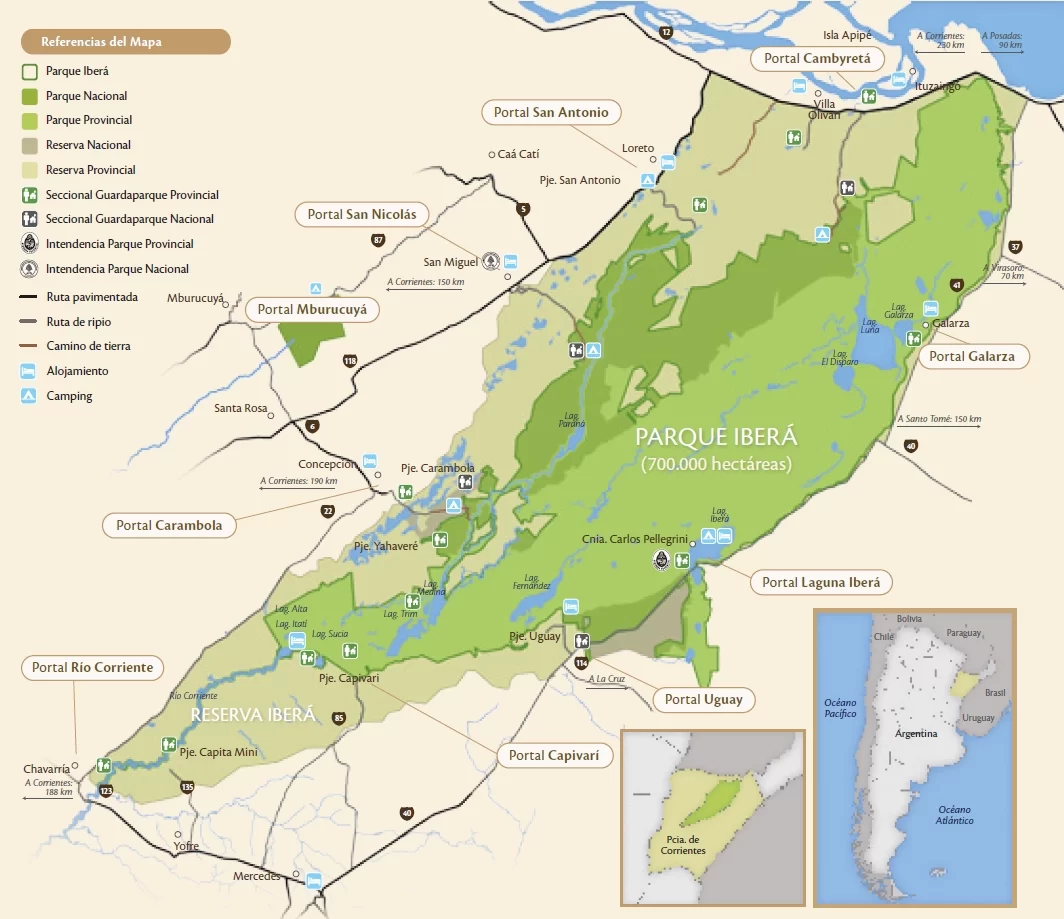
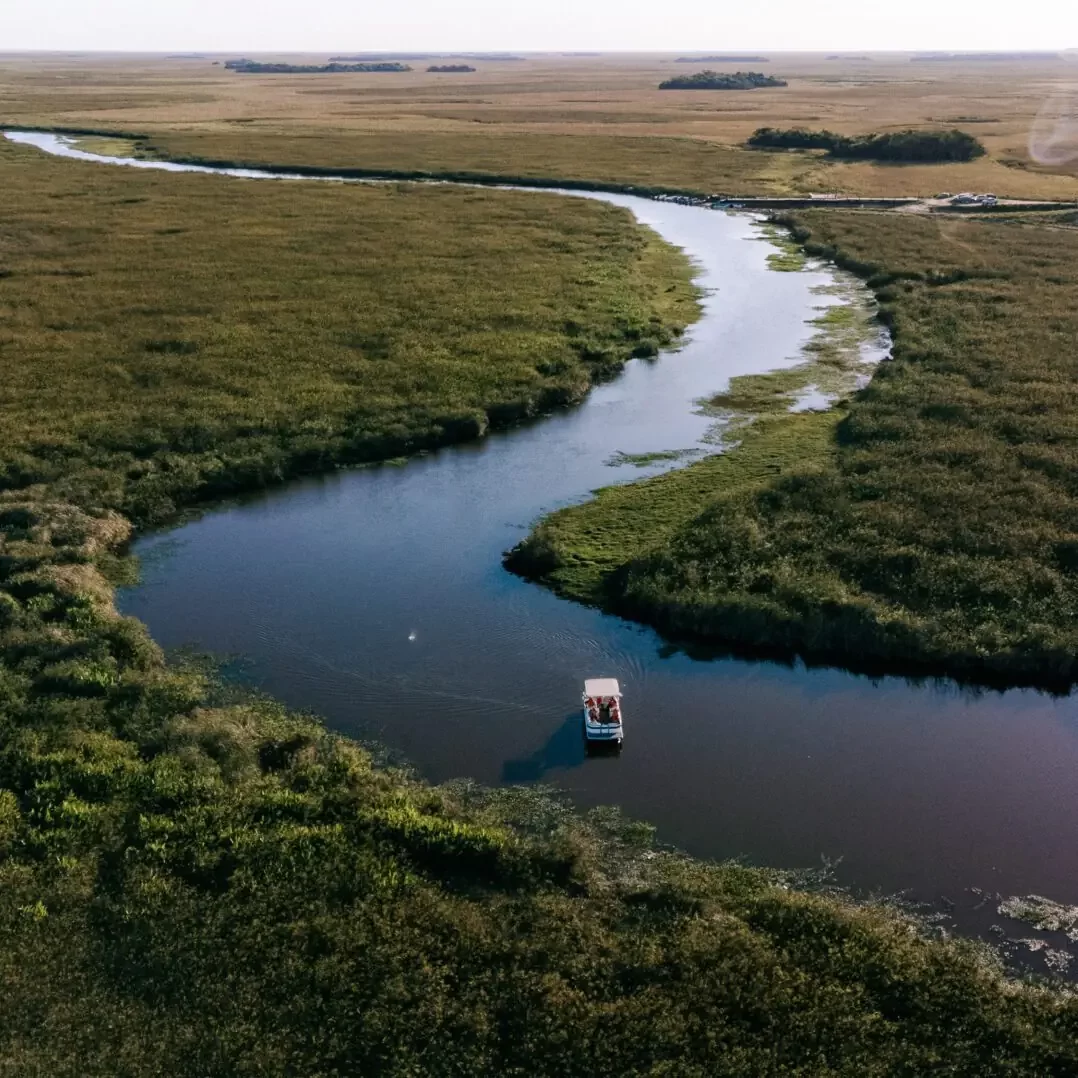
Iberá sits in the heart of Corrientes Province, between Buenos Aires and Iguazú Falls. The name comes from the Guaraní ý berá — “shining water” — and it is apt: this is a shifting mosaic of shallow lagoons, floating islands of vegetation, open marshes and golden grasslands covering an area larger than Yellowstone.
The modern protected area is the result of one of conservation’s great stories. Beginning in the late 1990s, Tompkins Conservation acquired and restored more than 150,000 hectares of former cattle ranches around the wetland, donating them to the Argentine state to create Iberá National Park in 2018. Combined with the surrounding provincial park, the Gran Parque Iberá now protects over 700,000 hectares — Argentina’s largest nature park — accessed through a series of gateways known as portales. El Tránsito sits inside the park at Portal Carambola, one of the quietest of these gateways, reached through the historic town of Concepción del Yaguareté Corá.
Why “Safari” Is the Right Word
Two things define a great safari: how much wildlife you see, and how close it lets you get. Iberá delivers on both. After decades of protection and rewilding, the animals here have lost their fear of people. Capybaras graze in the open like sheep. Yacaré caimans line the banks by the dozen. Marsh deer wade through the shallows in plain sight, and rheas stride across the grasslands. You do not need to search for wildlife in Iberá — you move through a landscape that is visibly, audibly full of it.
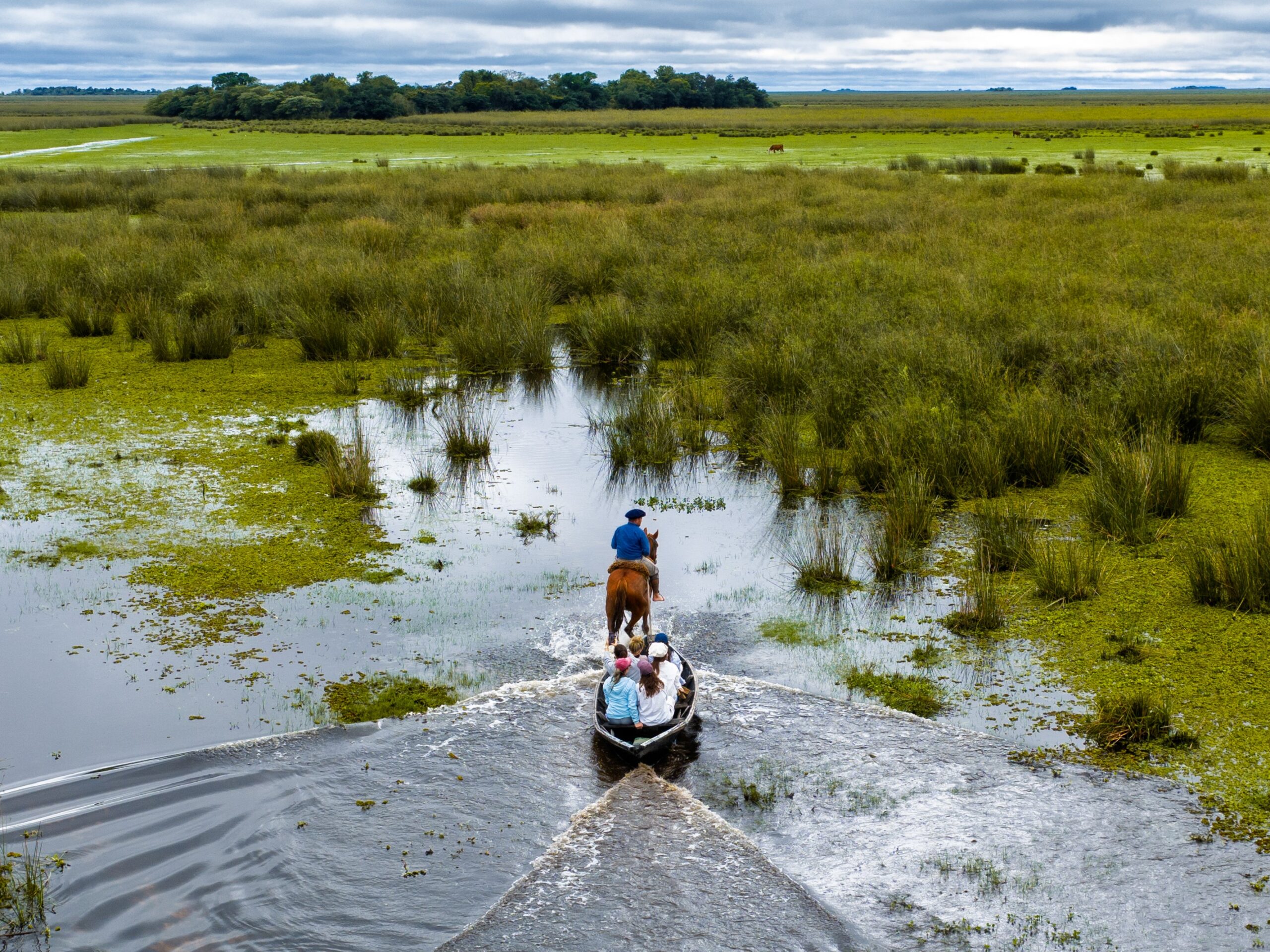
The rhythm is pure safari, too: out at dawn and dusk when the wetland is most alive, guided by people who grew up reading this landscape, in small private groups rather than crowded vehicles. The difference is the means of travel. Instead of a 4×4, your game drives happen by flat-bottomed boat gliding through channels of floating vegetation, on horseback through the grasslands, by kayak, or on foot along raised trails — quieter, closer, and gentler on the environment.
The Iberá Big Five
Every safari destination has its icons. These are Iberá’s:
- Jaguar (yaguareté). Hunted out of Iberá some 70 years ago, the jaguar returned in January 2021, when Rewilding Argentina released the first family into the park — the world’s first reintroduction of jaguars to a place where they had gone completely extinct. Today more than 35 jaguars roam free across three generations, and sightings, tracks and camera-trap records are multiplying every season. A jaguar sighting in Iberá is never guaranteed — this is a comeback in progress, not a zoo — but travelling here means witnessing, and funding, the most important big-cat recovery in the Americas.
- Giant anteater. The first species Rewilding Argentina brought back, in 2007. Watching this improbable, shaggy, two-metre animal amble across the grassland with a pup on its back is one of South America’s strangest and most wonderful wildlife encounters.
- Giant otter. One of the rarest mammals on the continent, also reintroduced to Iberá after decades of absence — a boisterous, social apex predator of the lagoons.
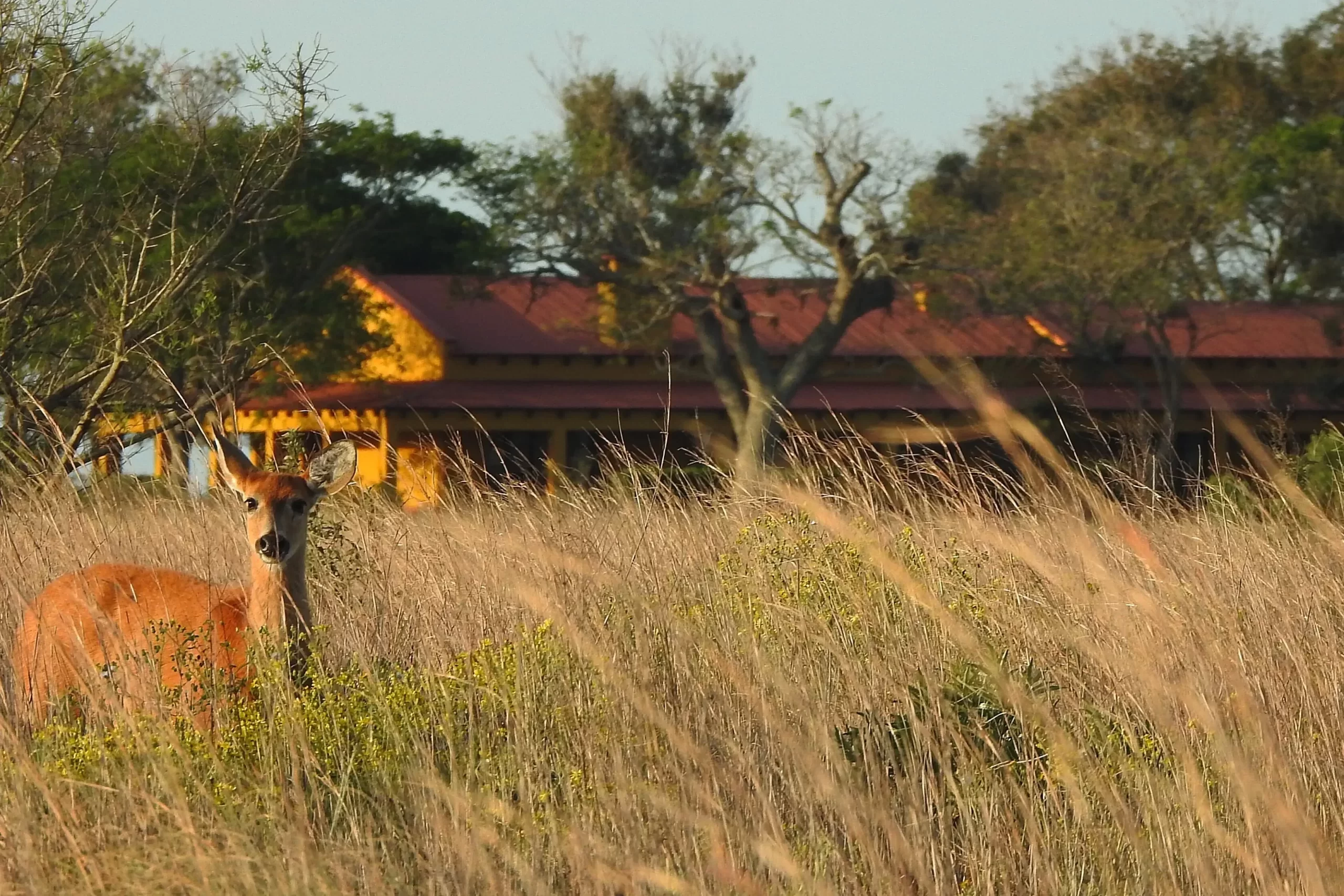
- Marsh deer. South America’s largest deer, perfectly at home belly-deep in the marshes. In Iberá you will see them daily, antlers rising above the reeds.
- Capybara (carpincho). The world’s largest rodent and the wetland’s unofficial host. They are everywhere — dozing on trails, grazing beside the lodge, escorting strings of pups along the water’s edge.
Honourable mentions: two species of yacaré caiman, neotropical river otters, black howler monkeys, pampas deer, foxes and armadillos — plus reintroduced collared peccaries, bare-faced curassows and red-and-green macaws.
A Birder’s Paradise
With more than 350 recorded species, Iberá is one of South America’s premier birding destinations. Icons include the giant jabiru stork, southern screamers duetting across the marsh, roseate spoonbills, the scarlet-headed blackbird, and the globally threatened strange-tailed tyrant — a grassland specialist that draws birders from around the world. Spring (September–November) brings spectacular nesting activity; for the full seasonal picture, see our guide to the best time to visit the Iberá Wetlands.
The Greatest Rewilding Story in the Americas
What makes Iberá more than a beautiful wetland is its story. Douglas and Kristine Tompkins’ conservation vision — carried forward today by Rewilding Argentina — has restored not just land but entire ecological roles: anteaters, pampas deer, peccaries, macaws, curassows, giant otters and, finally, the jaguar. The result is a landscape recovering its full, original cast of characters, protected within Iberá National Park.
For travellers, this matters in a very practical way: nature tourism is now the economic engine that sustains the park and its surrounding communities. Choosing Iberá is conservation-positive travel in the most direct sense — every stay helps keep the wild, wild.
What an Iberá Safari Actually Looks Like
A typical day from the lodge: coffee before first light, then a dawn boat safari through the channels as the mist lifts and the wetland wakes around you. Back for a long breakfast and a siesta through the warm hours — this is Argentina, after all. In the late afternoon, a horseback ride across the grasslands to a wildlife refuge, a kayak outing, or a guided walk, timed for the golden light and the evening surge of animal activity. Dinner is a three-course affair back at the lodge, under a sky with zero light pollution.
And then there is the experience found nowhere else: the horse-drawn canoe (canoa tirada a caballo), a revived Correntino tradition in which a horse wades through the shallows towing your canoe across the marsh — silent, slow, and utterly of this place. All excursions at El Tránsito are included in the rate and run in small private groups; see the full range of experiences.
Iberá or the Pantanal?
International travellers often weigh Iberá against Brazil’s Pantanal — fair, since they are the two great wetlands of South America. They are complementary rather than rivals:
Iberá Wetlands (Argentina) | Pantanal (Brazil) | |
Best for | Overall wildlife immersion, exclusivity, rewilding story | Highest probability of jaguar sightings |
Crowds | Very low — often no other boats in sight | Busy river sections in peak season |
Jaguars | Reintroduced 2021; 35+ and growing; sightings increasing but still very rare | Established population; boat-based sightings near-routine in season |
Experience | Boat, horseback, kayak, walking; small private groups | Mostly boat- and vehicle-based |
Combine with | Iguazú Falls & Buenos Aires in one itinerary | Amazon or Bonito circuits |
If you want the near-certainty of photographing a jaguar on a riverbank, the Pantanal remains the benchmark. If you want a wilder, quieter, more exclusive safari — with extraordinary wildlife density, a world-changing conservation story, and the possibility of crossing paths with a jaguar that owes its existence to rewilding — Iberá is the destination the trade is only beginning to discover.
Where to Stay: Inside the Park, at El Tránsito
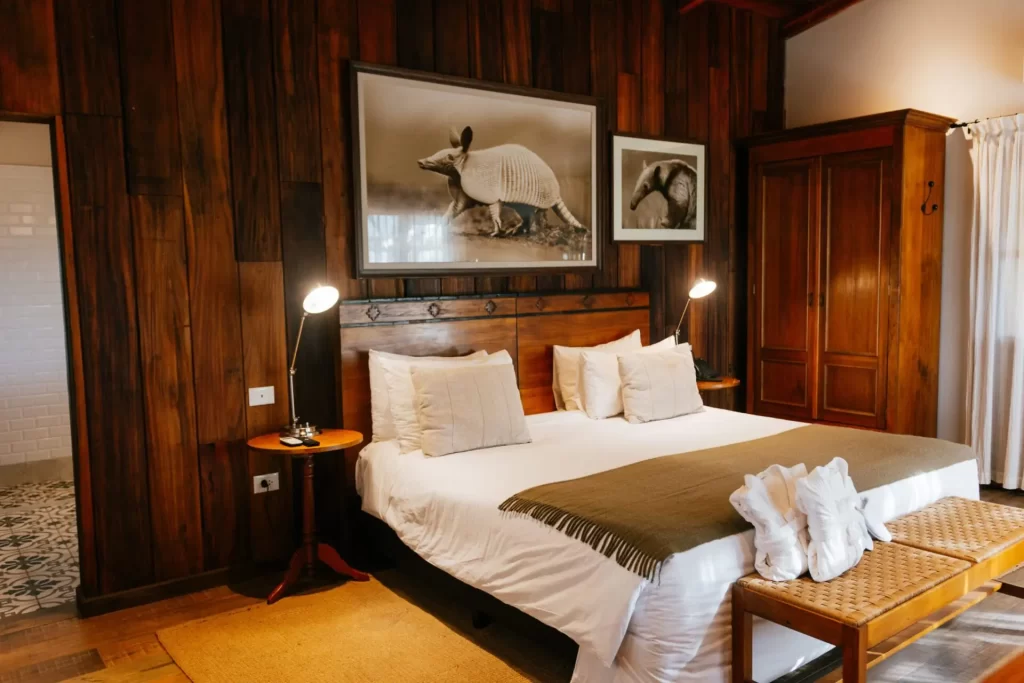
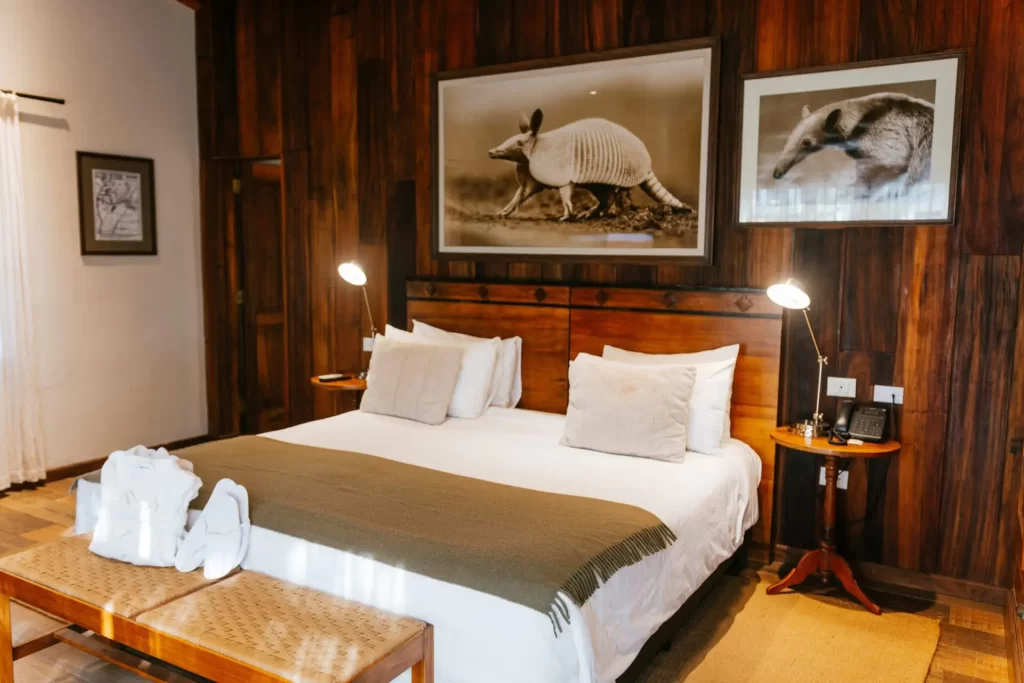
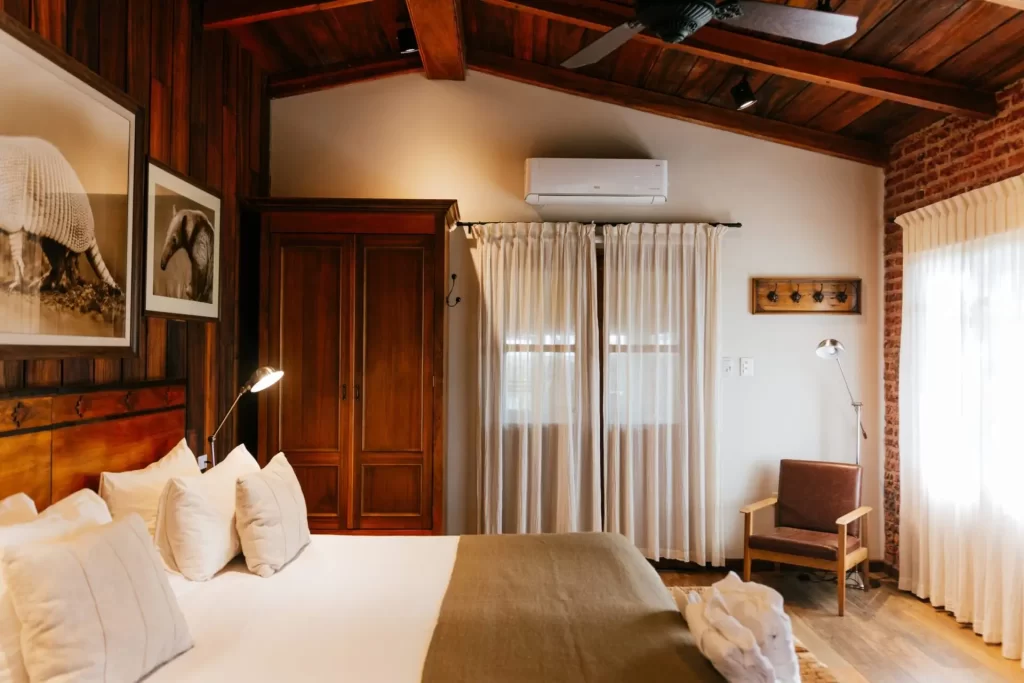
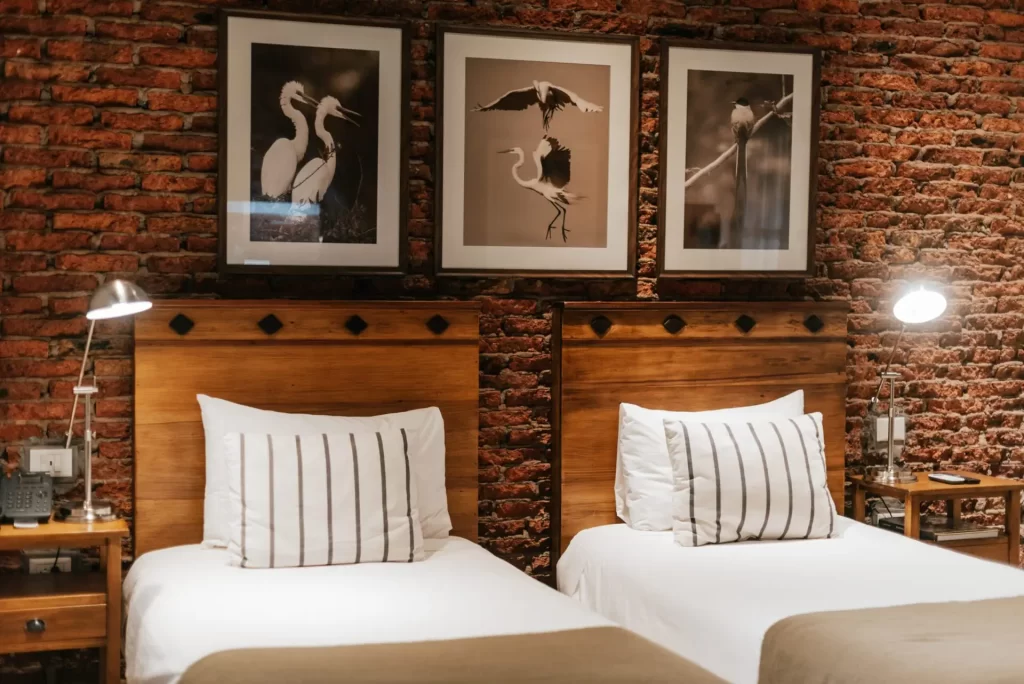
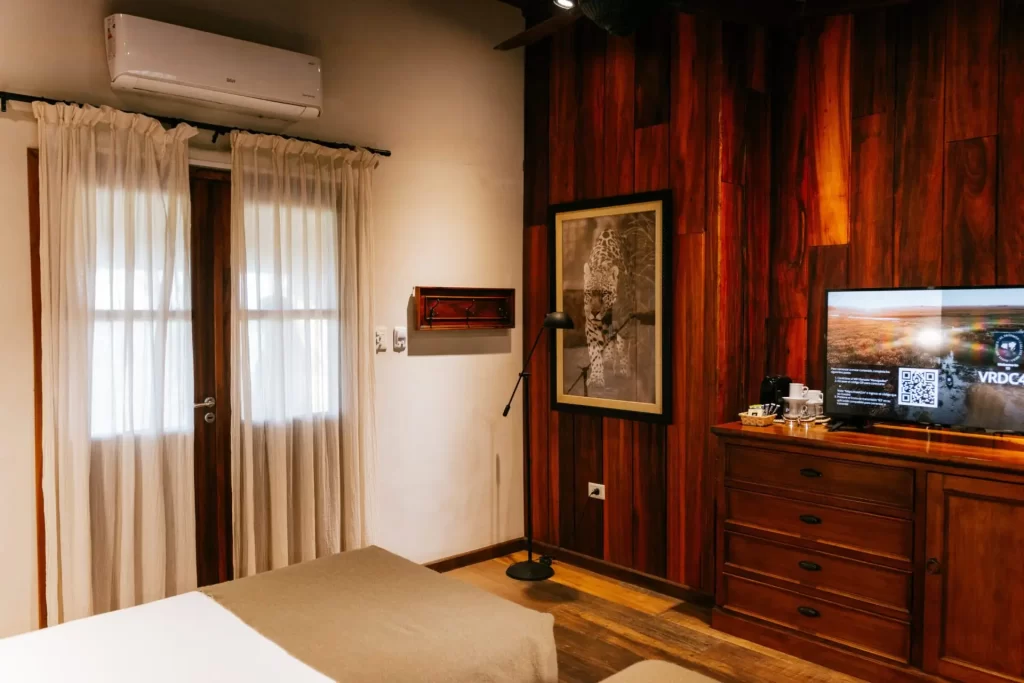
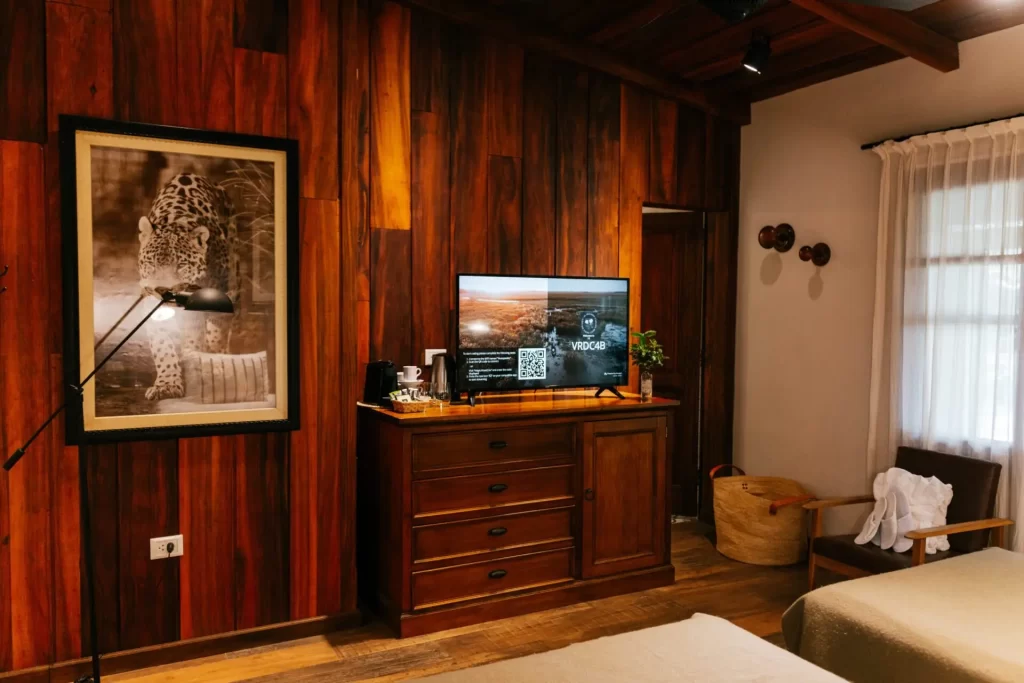
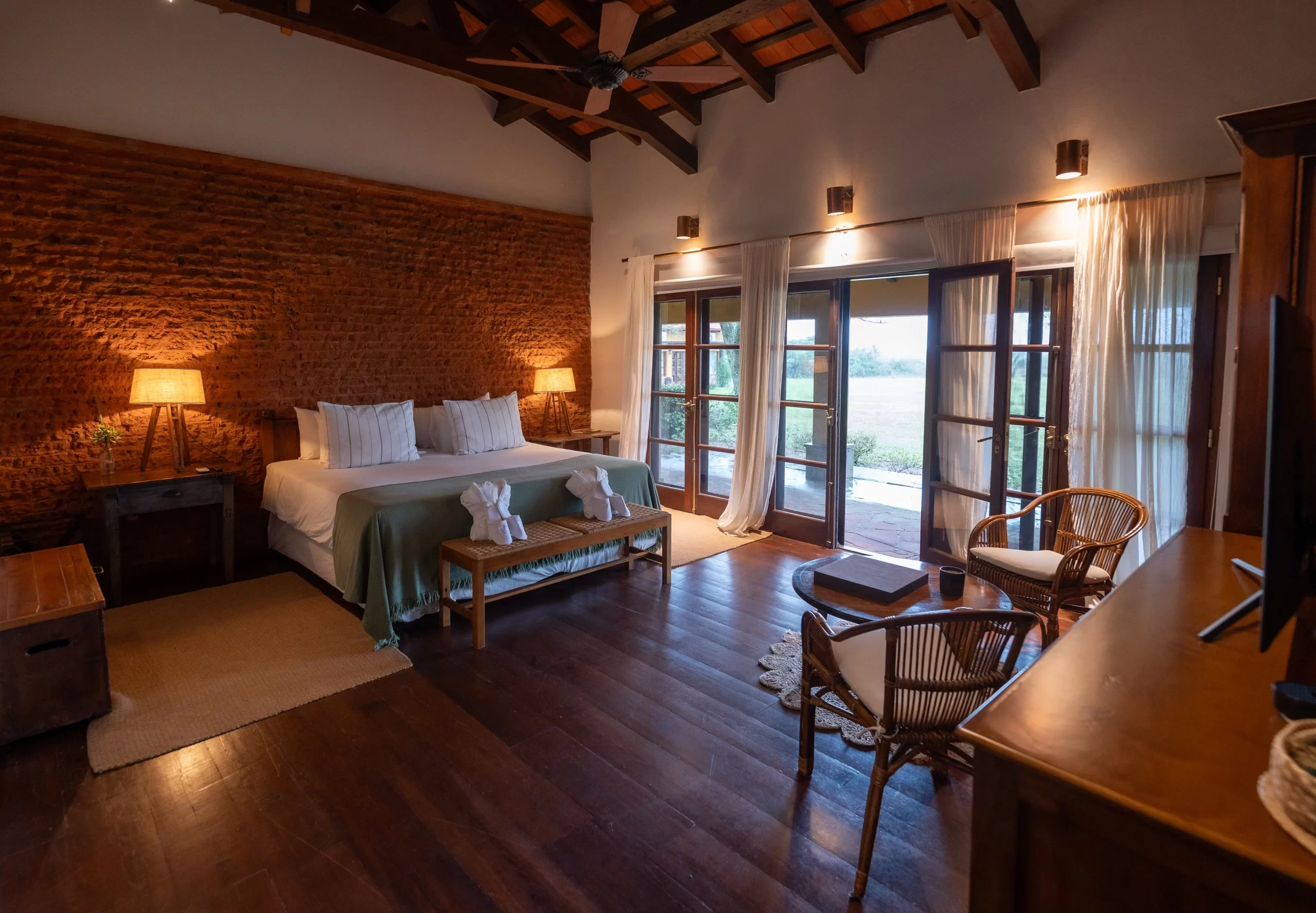
El Tránsito Nature Luxury Lodge occupies a beautifully restored 1921 estancia inside Iberá National Park, at Portal Carambola. With just 13 rooms across five categories — from Deluxe rooms to the standalone Casa Yaguareté — it operates on a full-board, all-inclusive basis: every meal (three-course lunches and dinners with drinks, including wine), and every guided experience — boat safaris, the horse-drawn canoe, horseback riding, kayaking, walks and cultural visits — is part of the rate.
There is no mobile signal here, only Wi-Fi at the lodge, a pool shaded by old trees, and wildlife wandering the grounds. It is a place built for what a safari should feel like: total immersion, without compromise on comfort. Browse the rooms and suites to find your fit.
Getting There
The nearest commercial airport is Corrientes (CNQ), with daily connections from Buenos Aires, followed by a 2.5–3 hour road transfer to the lodge. For a true safari-style arrival, El Tránsito has its own private 820-metre airstrip (LAD 3240), allowing charter and private aircraft to land directly at the lodge from Buenos Aires, Iguazú or elsewhere. Most international guests weave Iberá into a northern Argentina itinerary alongside Iguazú Falls and Buenos Aires — three to four nights in the wetlands is the ideal length of stay.
When Should You Go?
Iberá rewards visitors year-round, but each season offers something distinct — from prime wildlife viewing in the mild southern winter to nesting season in spring. We break it down month by month in our companion guide: Best Time to Visit the Iberá Wetlands.
Frequently Asked Questions
Plan Your Iberá Safari
Our team can help you design the perfect stay — from seasons and room categories to fly-in logistics and combining Iberá with Iguazú and Buenos Aires.